Forehead & Brow Descent
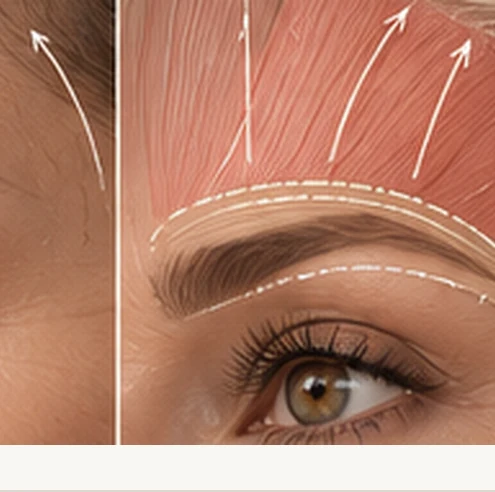
Age-related descent across the forehead-brow complex may contribute to a heavier or lower upper-face appearance.
FOREHEAD LIFT
Individual surgical planning for the forehead, brow position and upper-face balance.
A forehead lift is designed to address age-related changes across the forehead and brow complex. Surgical planning considers brow position, forehead soft tissues, facial proportions and the relationship between the central and lateral upper face, with the aim of improving balance while preserving natural expression.

THE UPPER FACE
The forehead and brows function as a connected anatomical and aesthetic unit. With ageing, changes in soft-tissue support and brow position can alter the appearance of the forehead, upper eyelids and lateral upper face. Forehead lift planning therefore begins by assessing the entire forehead-brow relationship rather than focusing on a single point of elevation.
Central and lateral brow position can affect how open or heavy the upper face appears. Assessment considers the distribution of brow descent, forehead proportions and surrounding anatomy to determine whether a broader forehead-based approach is appropriate.
AREAS OF CONCERN
The concerns addressed by forehead lift surgery vary between patients. Depending on individual anatomy and the pattern of upper-face ageing, assessment may focus on one or more of the following areas.
Age-related descent across the forehead-brow complex may contribute to a heavier or lower upper-face appearance.
Lowering of the central brow may influence the relationship between the brows, upper eyelids and forehead.
The outer brow is assessed as part of the broader forehead-brow complex rather than in isolation.
Changes in brow position and forehead soft tissues may contribute to a heavy appearance across the upper face.
The relationship between forehead height, brow shape and brow position is considered when planning the degree and direction of repositioning.
Previous brow or forehead surgery, threads, injectables or energy-based treatments may influence anatomy and surgical planning.
CANDIDACY
Forehead lift surgery may be considered when brow descent or upper-face heaviness involves a broader forehead-brow pattern rather than the lateral temple region alone. Candidacy depends on brow position, forehead proportions, tissue quality, previous procedures, general health and individual goals.
A forehead lift is not interchangeable with a temporal lift or every type of brow lift. The appropriate operation depends on whether the concern is primarily lateral, more broadly distributed across the forehead-brow complex, or focused on a specific aspect of brow position.
BEFORE SURGICAL PLANNING
Central and lateral brow height, shape, asymmetry and the pattern of descent are evaluated.
Forehead height, contour and its relationship to the brows and hairline are assessed.
The contribution of brow position to upper-eyelid heaviness is considered because brow descent and eyelid anatomy may coexist.
The temporal region and lateral brow are assessed to determine whether the concern is broader than a temporal lift alone.
Previous surgery, threads, injectable treatments and energy-based procedures are reviewed because they may affect tissue planes and planning.
Medical history, medications, smoking status and other factors that may influence anaesthesia, bleeding or wound healing are assessed.
AN ANATOMICAL APPROACH
A forehead lift is planned according to the distribution of brow descent and the patient's upper-face anatomy rather than a fixed degree of elevation. The forehead, central brow and lateral brow are considered together so that repositioning remains proportionate to the eyes, temples and overall facial structure.
When brow descent extends beyond the lateral region, focusing only on the temple may not address the full pattern. Surgical planning therefore determines which parts of the forehead-brow complex require support and in what direction.
SURGICAL PLANNING
Planning begins by defining the distribution of brow descent and determining how the forehead, brows, temples and upper eyelids contribute to the patient's concerns.
The forehead, brows, temples and upper-eyelid relationship are assessed as a connected anatomical unit.
Central and lateral brow position, shape and asymmetry are evaluated.
Forehead proportions, soft-tissue characteristics and relevant hairline anatomy are incorporated into the plan.
The assessment determines whether the concern is predominantly temporal, broadly forehead-based or focused on another aspect of brow position.
The extent and direction of repositioning are selected according to the anatomy that requires correction.
The final plan integrates forehead-brow balance, facial proportions and preservation of natural expression.
SURGICAL PHILOSOPHY
The objective of forehead lift surgery is not to create an excessively high or surprised brow position. Planning is directed toward improving support and upper-face balance while preserving the patient's natural brow character, facial proportions and expression.
A natural-looking result depends on appropriate patient selection, careful analysis of the forehead-brow complex and restraint in the amount and direction of repositioning.
RECOVERY & HEALING
Recovery after forehead lift surgery is gradual. Swelling, bruising, tightness and temporary changes in sensation can occur during the early postoperative period. Brow position and upper-face contours continue to evolve as swelling resolves and the tissues settle. The pace of recovery varies according to the extent of surgery and the individual healing response.
Swelling and bruising are expected to reduce progressively during the early healing period.
The forehead and brow continue to settle as postoperative swelling decreases and tissues adapt to their new position.
Postoperative follow-up is important to monitor healing, symmetry, brow position and the evolution of the surgical result.
FREQUENTLY ASKED QUESTIONS
A forehead lift is designed to address a broader forehead-brow complex, but the degree and distribution of repositioning are individual. Surgical planning depends on central and lateral brow position, forehead anatomy and the patient's concerns.
A temporal lift primarily focuses on the lateral brow and temple region. A forehead lift is considered when the pattern of brow descent or upper-face ageing is more broadly distributed across the forehead-brow complex.
Brow lift is a broader term that may refer to different operations designed to modify brow position. A forehead lift describes an approach in which the forehead-brow complex is assessed and treated more broadly. The appropriate procedure depends on anatomy and the distribution of brow descent.
It may improve heaviness when brow descent contributes to the appearance of the upper eyelid. Upper-eyelid anatomy must also be assessed because a forehead lift does not treat every cause of upper-eyelid heaviness.
The aim is not excessive elevation. Planning is based on brow shape, forehead proportions and the pattern of descent, with the objective of improving balance while preserving natural expression.
Previous injectable treatments, threads or other procedures do not automatically exclude surgery, but they should be reviewed because they may influence tissue behaviour, anatomy and surgical planning.
Recovery is gradual and varies between patients. Swelling, bruising and tightness can occur during the early phase, while brow position and upper-face contours continue to settle over time. A personalised recovery plan is discussed according to the extent of surgery and individual healing factors.
Forehead lift surgery can reposition and support tissues, but it does not stop the natural ageing process. The appearance will continue to evolve over time according to ageing, tissue quality, lifestyle and other individual factors.
RELATED PROCEDURES

TAKE THE FIRST STEP
Arrange a consultation to discuss the changes you have noticed in your forehead and brow region, and whether forehead lift surgery may be appropriate for your anatomy and goals.