Crusting
Dry crusts may repeatedly form around the edges of the perforation.
SEPTAL PERFORATION REPAIR
Individual assessment and surgical planning for symptomatic nasal septal perforation.
A septal perforation is an opening in the nasal septum that may cause symptoms such as crusting, bleeding, dryness, whistling or nasal obstruction. Management depends on the cause, size and location of the perforation, the condition of the surrounding tissue, previous surgery and the patient's individual symptoms.

UNDERSTANDING THE SEPTUM
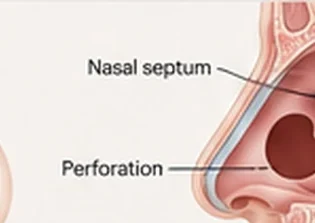
A septal perforation is a defect that creates an opening between the right and left sides of the nasal septum. Some perforations cause few or no symptoms, while others can disturb airflow, dry the edges of the opening and contribute to crusting, bleeding, whistling or a sensation of nasal blockage.
The clinical significance of a perforation depends on several factors, including its size, location, airflow around the opening, tissue quality and the condition of the remaining septal support.
POSSIBLE SYMPTOMS
Septal perforations vary considerably. Some are discovered incidentally, while symptomatic perforations may produce one or more of the following problems.
Dry crusts may repeatedly form around the edges of the perforation.
Fragile or dry mucosa around the opening may bleed intermittently.
Altered airflow can contribute to dryness, irritation or discomfort inside the nose.
Air passing through the perforation may create an audible whistling sound, particularly with smaller anterior defects.
Some patients describe a blocked sensation despite the presence of an opening in the septum.
Turbulent airflow may contribute to discomfort, crusting or a subjective change in nasal breathing.
POSSIBLE CAUSES
A septal perforation can develop when the mucosal lining and supporting tissues of the septum are damaged or lose their blood supply. Identifying a possible cause is an important part of assessment because it may influence both treatment and the likelihood of successful healing.
Prior surgery can alter septal tissue, blood supply and available support.
Nasal injury or repeated local trauma may damage the septal lining.
Repeated manipulation, cautery or other local factors may contribute in selected cases.
Certain inflammatory, autoimmune or systemic conditions may be relevant and require appropriate medical evaluation.
Some intranasal medications or substances can damage septal tissue when misused or chronically exposed.
In some patients, no single cause can be established despite assessment.
CANDIDACY
Not every septal perforation requires surgical closure. Treatment depends on the patient's symptoms, the cause of the perforation, its size and location, tissue quality, previous surgery, septal support and general health. Conservative treatment may be appropriate for some patients, while surgical repair may be considered when symptoms remain significant and the anatomy is suitable.

CLINICAL ASSESSMENT
Evaluation focuses on the perforation itself and on the quality of the surrounding mucosa, remaining septal support, nasal airway, previous surgical changes and any factors that may affect healing.
BEFORE SURGICAL PLANNING
The dimensions of the defect influence the available repair options and the technical complexity of closure.
Anterior and more posterior perforations can behave differently and may produce different symptoms.
The condition, mobility and vascularity of the surrounding mucosa are important when considering repair.
The remaining cartilage and structural support are assessed, particularly after previous surgery or trauma.
Prior procedures, trauma and other possible causes are reviewed because they can affect tissue availability and healing.
Septal alignment, nasal valves, turbinates and other contributors to obstruction are assessed when clinically relevant.
TREATMENT DEPENDS ON THE INDIVIDUAL
Management is guided by symptoms and clinical findings rather than by the presence of a perforation alone. Some patients can be managed without surgery, while others may be considered for repair when symptoms are persistent and the local anatomy is suitable.
Humidification, saline care, moisturising measures and avoidance of local trauma may help reduce dryness, crusting and irritation. In selected patients, a septal button may also be considered.
Surgery may be considered for symptomatic perforations when the cause has been appropriately evaluated and the surrounding tissues offer a reasonable basis for reconstruction.
Perforation size is important, but symptoms, location, tissue quality, previous surgery, remaining support and healing factors all influence whether surgical repair is appropriate.
RECONSTRUCTIVE PLANNING
Septal perforation repair is reconstructive surgery. The objective is to restore separation between the two nasal passages while protecting nasal support and creating the best possible conditions for tissue healing. The surgical approach depends on the individual defect and the available local tissue.
Depending on the anatomy, reconstruction may involve mobilisation of mucosal tissue, interposition material and structural support. The exact technique is selected according to the perforation, tissue quality and previous surgical history.
SURGICAL PLANNING
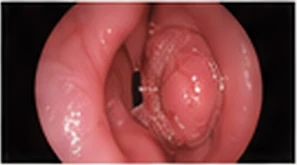
Planning begins with understanding why the perforation is symptomatic, what tissue remains available and which factors may influence healing or reconstruction.
Symptoms, previous surgery, trauma, medication or substance exposure and other relevant history are reviewed.
The size and location of the defect are documented and related to the patient's symptoms.
Surrounding mucosa, septal support and the effects of previous surgery are evaluated.
Septal alignment, valves, turbinates and other functional factors are considered where relevant.
The repair approach is selected according to tissue availability, defect characteristics and structural requirements.
The final plan integrates perforation repair, preservation of support and any additional clinically necessary functional reconstruction.
RECOVERY & HEALING
Healing after septal perforation repair is gradual and requires protection of the reconstructed tissues. Nasal congestion, internal swelling and crusting can occur during the early postoperative period. Follow-up is important because the repair site and nasal lining need to be monitored as healing progresses. The pace of recovery varies according to the size and location of the perforation, the reconstructive technique, tissue quality and individual healing response.
Internal swelling, congestion and crusting are expected to improve progressively as the nasal lining heals.
Postoperative care is directed toward reducing trauma, dryness and other factors that may interfere with healing.
The repair site is assessed during follow-up as tissues heal and nasal symptoms evolve over time.
FREQUENTLY ASKED QUESTIONS
No. Some septal perforations cause few or no symptoms and may be managed conservatively. Surgery is considered according to symptoms, cause, size, location, tissue quality, previous surgery and the individual patient's anatomy.
Possible symptoms include crusting, intermittent bleeding, dryness, irritation, whistling, altered airflow and a sensation of nasal obstruction. The pattern and severity vary between patients.
Established septal perforations generally do not close spontaneously. Symptoms may sometimes be controlled with conservative care, while surgical repair may be considered in selected symptomatic patients.
Size is important, but it is not the only factor. Location, symptoms, tissue quality, remaining septal support, previous surgery, the cause of the perforation and healing factors all influence treatment planning.
Previous nasal surgery does not automatically exclude repair, but it can change tissue availability, blood supply and structural support. These factors need to be assessed individually before deciding whether repair is appropriate.
A septal button is a prosthetic device that can be placed within the perforation in selected patients to reduce symptoms. It does not close the perforation biologically and is not suitable or comfortable for every patient.
It may improve symptoms in appropriately selected patients when the perforation contributes to disturbed airflow, crusting or obstruction. Other causes of nasal blockage must also be assessed because closing the perforation does not address unrelated airway problems.
Yes. Re-perforation is a recognised possibility after repair. The risk depends on factors including perforation characteristics, tissue quality, previous surgery, underlying causes and postoperative healing. Surgical closure cannot be guaranteed.
RELATED PROCEDURES

TAKE THE FIRST STEP
Arrange a consultation to discuss your symptoms, previous nasal surgery or trauma, and whether conservative management or surgical repair may be appropriate for your septal perforation.