Altered Anatomy
Previous surgery can change the structures that would normally guide surgical planning.
REVISION RHINOPLASTY
A careful approach to previously operated noses, balancing appearance, structure and breathing function.
Revision rhinoplasty is performed after previous nasal surgery when aesthetic, structural or functional concerns remain or have developed over time. Each case requires an individual assessment of the existing anatomy, scar tissue, nasal support, breathing function and the patient's priorities before a new surgical plan is considered.

A DIFFERENT STARTING POINT
A previously operated nose has a different starting point from a primary rhinoplasty. Prior surgery may have changed the cartilage framework, bone, soft tissues, internal support and healing characteristics of the nose.
Previous surgery can change the structures that would normally guide surgical planning.
Scar tissue and previous healing may affect dissection, skin-soft tissue behaviour and the predictability of refinement.
Appearance, support and breathing function need to be considered together when planning further surgery.
REASONS FOR REASSESSMENT
Revision rhinoplasty may be considered when concerns remain after a previous rhinoplasty or when new aesthetic, structural or breathing problems have developed during healing. The reason for reassessment is different for every patient, and not every concern requires further surgery.
Residual concerns involving the bridge, tip, width, projection, rotation or overall balance.
Visible asymmetry, contour irregularities or differences that become more apparent after healing.
Structural weakness may affect tip support, nasal shape or the stability of the airway.
Nasal obstruction may relate to the septum, nasal valves, scar tissue or structural changes.
Previous changes may have produced a result that does not match the patient's anatomy, function or original goals.
Trauma or the individual healing response may alter the postoperative result over time.
CANDIDACY
Suitability for revision rhinoplasty depends on the reason for concern, the condition of the nasal tissues, breathing function, previous surgical changes, general health, healing history and realistic expectations. Adequate time after the previous operation is also important, because swelling and tissue remodelling can continue for many months.

REAL CONSULTATION
A consultation focuses on the previous operation, current anatomy, breathing, tissue quality, patient priorities and what can realistically be improved with further surgery.
REVISION RESULTS
Revision rhinoplasty outcomes depend on the starting anatomy, previous surgical changes, tissue quality, available structural support, surgical goals and individual healing. Each case should be understood in the context of its own limitations and possibilities.
PREOPERATIVE ASSESSMENT
The type and extent of previous nasal surgery, available operative information and the patient's healing history are reviewed where possible.
The bridge, tip, symmetry, projection, rotation, width, skin-soft tissue envelope and visible support are examined.
The septum, nasal valves, airway and other internal structures are assessed in relation to breathing function.
Previous healing, scarring and tissue characteristics may influence what can safely and predictably be changed.
Existing septal cartilage and, when needed, alternative graft sources are considered as part of structural planning.
The concerns that matter most to the patient are discussed and balanced against anatomy, function and realistic surgical possibilities.
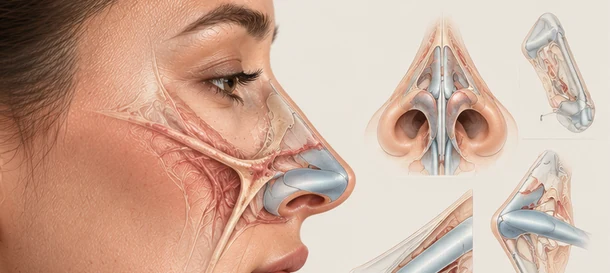
REBUILDING SUPPORT WHEN NEEDED
Some revision cases require additional cartilage to restore or reinforce nasal support. The need for grafting depends on what remains after previous surgery and on the structural goals of the revision. Septal cartilage may be limited in a previously operated nose; in selected cases, ear or rib cartilage may be considered when additional graft material is required.
The choice of graft material is based on the patient's anatomy, the amount and strength of cartilage required, previous surgery and the specific reconstructive objective. Not every revision rhinoplasty requires rib cartilage.
FORM, SUPPORT & FUNCTION
In revision rhinoplasty, aesthetic concerns cannot always be separated from structural support and nasal function. A change intended to improve contour may also affect stability or airflow, while functional reconstruction may influence the external shape of the nose. For this reason, the revision plan considers appearance, support and breathing as interconnected elements.
The objective is to improve the concerns that can reasonably be addressed while preserving or restoring structural stability and nasal function where clinically relevant.
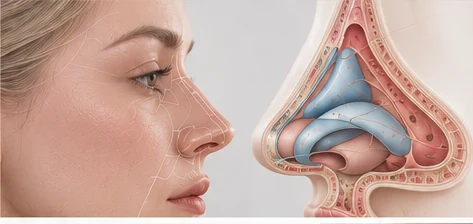
REVISION SURGICAL PLANNING
Revision planning begins by understanding both the current nose and the history that created it. The objective is not to recreate a standard shape, but to define what can be improved safely and meaningfully within the existing anatomy and tissue conditions.
Previous operations, healing, current concerns and available operative information are reviewed.
Nasal shape, support, symmetry, skin-soft tissue characteristics and the airway are assessed together.
Areas of remaining support, weakness, scar tissue and possible graft requirements are identified.
Septal alignment, nasal valves and other factors affecting breathing are evaluated where clinically relevant.
The patient's priorities are discussed in relation to what the tissues and anatomy can reasonably allow.
A surgical plan is developed to address the most important aesthetic, structural and functional findings while respecting the limitations of a previously operated nose.
RECOVERY & HEALING
Recovery after revision rhinoplasty is gradual and varies according to the extent of surgery, previous operations, tissue characteristics, grafting and individual healing. Early swelling, bruising and nasal congestion generally improve progressively, while residual swelling – particularly in areas that have been previously operated on – may take longer to settle. The final result develops over time rather than at a single fixed point.
Swelling, bruising and congestion are expected to improve gradually during the initial healing period.
Timing depends on the extent of surgery, visible swelling, work requirements and individual recovery.
Tissue remodelling and residual swelling may continue for many months, and revision cases can require particular patience during this process.
REVISION RHINOPLASTY FAQ
The appropriate timing depends on the previous operation and the patient's healing. Because swelling and tissue remodelling can continue for many months, revision surgery is usually considered only after the nose has had sufficient time to heal and stabilise. The timing is assessed individually.
Revision surgery often involves altered anatomy, scar tissue and changes in structural support from previous surgery. These factors can make planning and surgery different from a primary rhinoplasty, but the degree of complexity varies from case to case.
Not necessarily. The need for graft material depends on the existing nasal support and the goals of surgery. Septal or ear cartilage may be suitable in some cases, while rib cartilage may be considered when a larger or stronger graft source is required.
When breathing problems are related to structural issues such as septal deviation, nasal valve weakness, scar tissue or loss of support, functional correction may be incorporated into the revision plan where clinically appropriate.
Not every concern can be completely corrected. Previous surgery and healing can create anatomical and tissue limitations. The aim is to identify what can reasonably be improved and to establish realistic goals before surgery.
Recovery varies. Previous surgery, scar tissue, the extent of revision and grafting can influence swelling and healing. Some revision cases may take longer to refine than primary rhinoplasty.
Incisions depend on the surgical approach and on previous scars. When an external columellar incision is required, it is positioned discreetly. Any additional graft-harvest incision, if needed, is discussed during surgical planning.
If available, previous operative reports, preoperative photographs and information about earlier procedures can be helpful. Current photographs and a clear description of aesthetic and breathing concerns are also important for the initial assessment.
RELATED PROCEDURES

TAKE THE FIRST STEP
Send your photographs and information about your previous nasal surgery for an initial assessment, or arrange a consultation to discuss your concerns, breathing function and what may realistically be possible with revision surgery.