
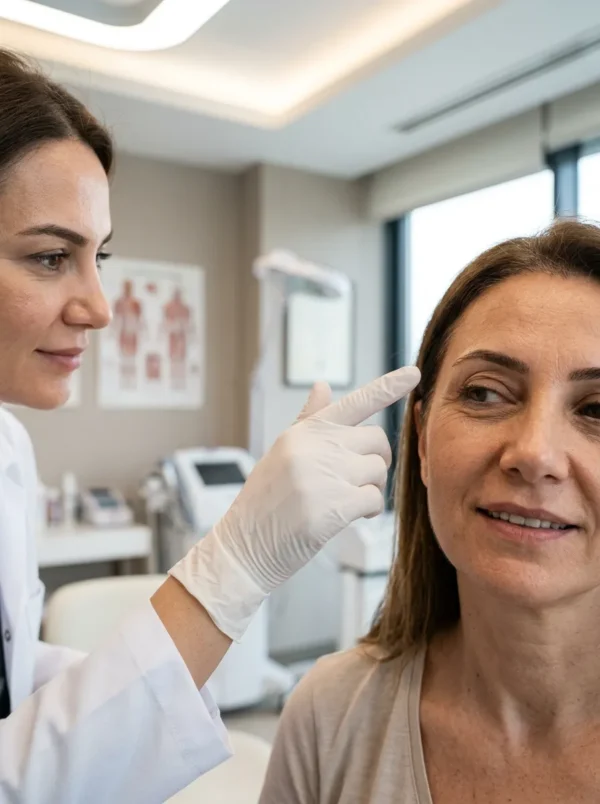


Eye Wrinkle Treatment
- Açıklama
- Değerlendirmeler (0)
Açıklama
Comprehensive Guide to Eye Wrinkle Treatment: Professional Solutions for Youthful Eyes
The Science Behind Eye Wrinkles: Why the Periocular Area Ages First
The Science Behind Eye Wrinkles: Why the Periocular Area Ages First Get an expert opinion.
Your initial assessment is free.
The skin surrounding the eyes, known as the periocular area, is uniquely susceptible to the early signs of aging. Unlike the skin on the rest of the face, the skin around the eyes is significantly thinner—often measuring only about 0.5mm in thickness. This lack of subcutaneous fat and a lower density of sebaceous glands means the area is prone to dehydration and loses elasticity much faster than the cheeks or forehead.
Eye wrinkle treatment is not merely a matter of vanity but a specialized field of facial aesthetics that addresses the biological degradation of collagen and elastin fibers. As we age, the body’s natural production of these structural proteins slows down. Furthermore, the eyes are the most active part of the face. We blink approximately 10,000 to 20,000 times a day, and our eyes are central to every facial expression, from squinting in the sun to laughing. These repetitive movements lead to the formation of dynamic wrinkles, which eventually settle into permanent, static lines.
To effectively manage these changes, one must understand that rejuvenation requires a multi-faceted approach. Whether through topical interventions, non-invasive procedures like Botox, or surgical corrections, the goal is to restore the structural integrity of the skin and the underlying tissues.
Understanding the Anatomy of Aging Eyes
Understanding the Anatomy of Aging Eyes Get an expert opinion.
Your initial assessment is free.
To choose the correct eye wrinkle treatment, it is essential to identify what is happening beneath the surface. The aging process in the eye area involves three main components: skin quality, muscle activity, and volume loss.
- Skin Laxity: The breakdown of the extracellular matrix leads to crepey skin. This is often exacerbated by UV exposure, which causes solar elastosis.
- Muscle Hyperactivity: The orbicularis oculi muscle, which encircles the eye, is responsible for closing the lids and squinting. Over time, its constant contraction creates the radiating lines known as crow’s feet.
- Fat Pad Migration: In youth, fat pads are well-distributed, providing a smooth transition between the lower lid and the cheek. As we age, these pads can either protrude (causing bags) or atrophy (causing hollows), making wrinkles appear more prominent.
Common Types of Eye Wrinkles and Fine Lines
Common Types of Eye Wrinkles and Fine Lines Get an expert opinion.
Your initial assessment is free.
Not all wrinkles around the eyes are created equal. Identifying the specific type of line is the first step in a professional consultation with an expert like Prof. Dr. Selçuk İnanlı.
Dynamic Wrinkles
Dynamic Wrinkles Get an expert opinion.
Your initial assessment is free.
These are lines that appear only when you are making an expression. When you smile or squint, the skin bunches up. In younger skin, the skin snaps back to a smooth state once the muscle relaxes. However, as elasticity fades, these lines begin to linger.
Static Wrinkles
Static Wrinkles Get an expert opinion.
Your initial assessment is free.
Static wrinkles are visible even when the face is at rest. These are caused by long-term damage from environmental factors, smoking, and the natural aging process. Treating static wrinkles often requires more intensive methods than dynamic ones, as the “fold” is already etched into the dermis.
Crow’s Feet (Lateral Canthal Lines)
Crow’s Feet (Lateral Canthal Lines) Get an expert opinion.
Your initial assessment is free.
These are the radiating lines that branch out from the outer corners of the eyes. They are often the first sign of aging people notice. While they are often associated with a “happy” face, deep crow’s feet can make an individual look significantly older than they are.
Under-Eye Crepiness and Fine Lines
These are the small, crisscross lines that appear directly under the lower lash line. They often result from a combination of thin skin and chronic dehydration. If you are looking to say goodbye to wrinkles in this area, a combination of skin boosters and moisture-retaining treatments is usually required.
Non-Surgical Eye Wrinkle Treatment Options
For many patients, the journey toward rejuvenation begins with non-surgical options. These treatments offer the advantage of minimal downtime and immediate to semi-immediate results.
Botulinum Toxin (Botox) for Crow’s Feet
Botox remains the gold standard for treating dynamic wrinkles. By temporarily relaxing the orbicularis oculi muscle, Botox prevents the skin from folding during facial expressions. This not only smoothes existing lines but also acts as a preventive measure against the formation of deeper static wrinkles. When performed by a skilled surgeon, the result is a refreshed look that maintains natural movement without the “frozen” appearance.
Dermal Fillers for Tear Troughs
Sometimes, what looks like a wrinkle is actually a shadow caused by volume loss. The tear trough is the area between the lower eyelid and the upper cheek. When this area becomes hollow, it creates a dark circle and makes the skin above it look saggy. Injecting dermal fillers—typically hyaluronic acid-based—can fill this hollow, smoothing the transition and effectively reducing the appearance of wrinkles.
Mesotherapy and Skin Boosters
Mesotherapy involves micro-injections of vitamins, minerals, and hyaluronic acid directly into the mesoderm (middle layer of the skin). For the eye area, this provides deep hydration and stimulates the production of collagen. Skin boosters work similarly, improving skin texture and “plumping” the fine lines that topical creams cannot reach.
Chemical Peels and Laser Resurfacing
Professional-grade chemical peels can exfoliate the top layers of the skin, encouraging cell turnover. For deeper wrinkles, fractional CO2 lasers or Erbium lasers create micro-injuries in the skin, triggering a robust healing response that replaces old, damaged tissue with new, collagen-rich skin. This is particularly effective for the “crepey” texture often found under the eyes.
Surgical Eye Wrinkle Treatment: Blepharoplasty and Beyond
When skin laxity is significant or when there are pronounced “bags” under the eyes, non-surgical methods may provide only marginal improvement. In these cases, surgical intervention is the most effective and long-lasting eye wrinkle treatment.
Upper Blepharoplasty
Upper eyelid surgery involves removing excess skin and, if necessary, small amounts of fat that cause the eyelid to look hooded or saggy. By tightening this area, the eyes appear more open, and the folds that contribute to a wrinkled appearance are eliminated.
Lower Blepharoplasty
Lower eyelid surgery is designed to address under-eye bags and deep wrinkles. Prof. Dr. Selçuk İnanlı often utilizes techniques that redistribute fat rather than just removing it, ensuring that the patient does not end up with a “hollowed-out” look. This surgery provides a dramatic smoothing effect that can last for a decade or more. For more details on this procedure, you can explore eyelid aesthetics.
Brow Lift Integration
In some instances, what appears to be excess skin on the upper eyelid is actually caused by a drooping brow. A brow lift (forehead lift) can reposition the eyebrow to its youthful height, naturally smoothing out the wrinkles around the brow and the upper eye area. Combining a brow lift with blepharoplasty is a common strategy in comprehensive facial rejuvenation.
The Role of Collagen, Elastin, and Modern Biostimulators
The foundation of youthful skin is a healthy dermis. Traditional treatments focused on filling or freezing, but modern eye wrinkle treatment increasingly focuses on biostimulation.
Biostimulators are substances that, when injected, stimulate the body’s own fibroblasts to produce collagen. While hyaluronic acid fillers provide volume, biostimulators like Polynucleotides (PDRN) or Calcium Hydroxylapatite (in diluted forms) focus on long-term skin quality. These are becoming highly popular for the under-eye area because they strengthen the thin skin, making it more resilient to the constant movement of the eye muscles.
Why Collagen Declines
Beyond age, external factors like UV radiation and pollution generate free radicals. These unstable molecules break down collagen strands. This is why a professional treatment plan always includes a recommendation for high-SPF sun protection and antioxidant-rich skincare.
Holistic Approaches: Skincare and Lifestyle Integration
While clinical treatments provide the heavy lifting, daily maintenance is what preserves the results. A robust home-care routine should focus on three pillars: protection, hydration, and correction.
- Retinoids: Derivatives of Vitamin A are the most studied ingredients for eye wrinkles. They accelerate cell turnover and boost collagen. However, because the eye area is sensitive, specialized eye-grade retinols or bakuchiol are recommended.
- Peptides: These short chains of amino acids act as messengers, telling the skin to produce more protein. They are excellent for maintaining the skin’s thickness.
- Vitamin C: A powerful antioxidant that brightens the under-eye area and protects against further oxidative damage.
- Hydration: Ingredients like Ceramides and Hyaluronic Acid are essential to keep the skin barrier intact, preventing the “dried-out” look that makes fine lines more visible.
The Impact of Lifestyle
No eye wrinkle treatment can fully overcome the effects of poor lifestyle choices. Smoking is particularly destructive as it constricts blood flow to the skin and actively destroys collagen. Adequate sleep is also vital; the term “beauty sleep” is rooted in science, as the skin undergoes its primary repair processes during deep sleep cycles. Furthermore, chronic salt intake and dehydration can cause fluid retention, leading to puffiness that stretches the skin and eventually causes more wrinkles.
Choosing a Specialist for Eye Rejuvenation in Istanbul
The eyes are a delicate and complex anatomical region. Choosing the right practitioner is the most important decision a patient will make. Prof. Dr. Selçuk İnanlı, with his extensive background in Otorhinolaryngology and Facial Plastic Surgery, brings a unique perspective to eye wrinkle treatment.
A specialist must understand the balance between the functional aspects of the eye (such as the ability to close the lids properly) and the aesthetic goals. In Istanbul, the trend is moving toward “Natural Rejuvenation.” This means avoiding the over-filled or over-pulled look. Instead, the focus is on restoring the patient’s unique anatomy to a version that looks 10 to 15 years younger.
The Consultation Process
During a consultation, the doctor will evaluate:
* The degree of skin laxity.
* The presence of fat prolapse (bags).
* The depth of the tear trough.
* The quality of the skin (pigmentation and texture).
* The patient’s medical history and aesthetic goals.
This comprehensive evaluation ensures that the chosen treatment—whether it is a simple Botox injection or a complex surgical blepharoplasty—is tailored to the individual’s needs.
Recovery and Aftercare for Eye Treatments
Recovery varies significantly depending on the intensity of the treatment. For non-surgical options like fillers or Botox, there is virtually no downtime, though minor bruising can occur.
For surgical treatments like blepharoplasty, the recovery process is as follows:
* Days 1-3: Swelling and bruising are at their peak. Cold compresses are essential.
* Days 5-7: Sutures are typically removed. Most patients feel comfortable appearing in public with sunglasses.
* Weeks 2-4: Residual swelling fades, and the final results begin to emerge.
Following the post-operative instructions provided by the clinic is crucial for preventing complications and ensuring the longevity of the results. This includes avoiding strenuous exercise, protecting the area from the sun, and using prescribed eye drops or ointments.
Future Trends in Eye Rejuvenation
The field of facial aesthetics is constantly evolving. We are seeing a shift toward regenerative medicine. Techniques such as Autologous Fat Transfer (using the patient’s own fat) and PRP (Platelet-Rich Plasma) therapy are being refined to provide even more natural and long-lasting results. These treatments use the body’s own healing cells to rejuvenate the eye area from the inside out.
Furthermore, the use of AI-driven skin analysis allows doctors to predict how the eye area will age, enabling more precise preventive treatments. As technology advances, the goal remains the same: to provide patients with a bright, rested, and youthful gaze that reflects their inner vitality.
By understanding the various levels of eye wrinkle treatment, from the simplest topical creams to the most advanced surgical techniques, patients can make informed decisions about their aesthetic journey. Under the guidance of an expert like Prof. Dr. Selçuk İnanlı, achieving a rejuvenated appearance is both safe and highly effective.
Sıkça Sorulan Sorular
What is the best age to start eye wrinkle treatment?
There is no single ‘perfect’ age to start eye wrinkle treatment, as the aging process is influenced by genetics, lifestyle, and environmental exposure. However, many aesthetic professionals recommend a preventive approach starting in the late 20s or early 30s. At this stage, non-invasive treatments like Botox can prevent dynamic lines from becoming deep-set static wrinkles. For those in their 40s and beyond, more corrective measures such as fillers or surgical blepharoplasty may be more appropriate to address volume loss and skin laxity that have already occurred.
How long do the results of non-surgical treatments like Botox and fillers last around the eyes?
The longevity of non-surgical treatments depends on the specific product used and the patient’s metabolism. Botox typically lasts between 3 to 4 months in the crow’s feet area due to the high muscle activity. Dermal fillers in the tear trough area tend to last longer, often between 9 to 18 months, because there is less movement in that specific region compared to the lips or nasolabial folds. Regular maintenance sessions are required to sustain the rejuvenated look over the long term.
Is eyelid surgery (blepharoplasty) the only way to fix sagging eye skin?
While blepharoplasty is the most definitive and long-lasting solution for significant skin sagging and fat bags, it is not the only option for milder cases. Advanced laser resurfacing and radiofrequency treatments can tighten the skin to a certain degree by stimulating collagen production. However, these non-surgical methods cannot remove excess skin or reposition displaced fat pads. A consultation with a specialist like Prof. Dr. Selçuk İnanlı is necessary to determine if your skin laxity requires a surgical or non-surgical approach.
Can I combine Botox and dermal fillers for a more comprehensive eye rejuvenation?
Yes, combining Botox and dermal fillers is a very common and effective strategy known as a ‘liquid facelift’ for the eyes. Botox addresses the dynamic wrinkles (crow’s feet) caused by muscle movement, while fillers address the hollows and volume loss (tear troughs) that create shadows and a tired appearance. Using these treatments in tandem provides a synergistic effect that smoothes the skin and restores youthful contours simultaneously, offering a much more balanced result than using either treatment alone.
What is the downtime associated with professional eye wrinkle treatments?
The downtime varies according to the intensity of the procedure. For Botox and fillers, there is essentially zero downtime, though some patients may experience minor swelling or a small bruise for a few days. Laser resurfacing may require 5 to 7 days of recovery as the skin heals and peels. Surgical options like blepharoplasty involve a more significant recovery period, typically 7 to 10 days for the initial swelling and bruising to subside enough for social activities, with full internal healing taking several months.



Değerlendirmeler
Henüz değerlendirme yapılmadı.